The Western Cape’s riding season is picking back up. Winter kept most bikes parked through the wet, windy months, and now the roads are calling. You roll your motorcycle out, turn the key, and get a click, a groan, or nothing at all.
Before you assume the worst, know this: a motorcycle battery that’s been sitting for a few months isn’t automatically dead. It might just need a proper charge, or a quick test to confirm what’s actually going on. This guide walks you through exactly how to check your motorcycle battery before you ride, what the readings mean, and when it’s genuinely time to replace it rather than fight with it.
Skip the guesswork. A five-minute check with a multimeter will tell you more than a week of frustrated key-turning.
Why Your Motorcycle Battery Loses Charge Over Winter
Even a battery that’s never been touched will lose charge just sitting in your garage. Two separate processes are working against it.
Self-Discharge Explained
Every battery discharges on its own, even fully disconnected from anything. This is a normal chemical process, but the rate varies hugely by battery type. A traditional lead-acid motorcycle battery can lose 5% to 10% of its charge per month through self-discharge alone, with heat speeding up the reaction significantly. Lithium batteries behave very differently: they typically lose only 1% to 2% of their charge per month, which is why a lithium battery can often sit through an entire winter and still start the bike, while a lead-acid battery struggles after a few weeks.
Parasitic Drain from Modern Electronics
Self-discharge isn’t the only thing pulling your battery down. If your battery stays connected to the bike over winter, small electronic systems like the ECU memory, dash clock, alarm, or tracker keep drawing a trickle of current the whole time. This is called parasitic draw, and on a modern bike loaded with electronics, it can be the faster of the two drains. A healthy, fully charged battery without any parasitic draw might hold a starting charge for three to six months, but modern electronics can shorten that to just two to four weeks. That’s a big part of why a battery that seemed fine in June can be flat by August.
Does Cape Town’s Winter Actually Kill Batteries?
Most advice on this topic is written for places where motorcycles get parked because of snow and sub-zero temperatures. That’s not the Western Cape’s problem.
Wet and Windy vs. Deep Freeze: Why Local Storage Risk Is Different
Cape Town riders don’t lose their batteries to frost. They lose them to time. The Western Cape enjoys a nine-month riding season, with the winter months of June to August generally being too windy and wet for enjoyable riding rather than too cold. That means bikes here typically sit idle for the same two to three months that would kill a lead-acid battery anywhere else, purely from self-discharge and parasitic draw, not from freezing damage. The mechanism is different, but the outcome for your battery is the same: a flat or weak start when you finally head out. South Africa
Heat Swings Heading Into Summer
There’s a second local factor worth knowing. As Cape Town moves from a mild, wet winter into a hot, dry summer, battery self-discharge speeds up with rising temperatures. A battery that was borderline in July can be noticeably worse by the time the December heat arrives if it isn’t checked and charged in between. Testing your battery now, at the start of the season, catches problems before summer temperatures make them worse.
How to Test Your Motorcycle Battery Before You Ride
You don’t need a workshop for this. A basic digital multimeter, available for a small outlay, is all you need.
Reading Resting Voltage With a Multimeter
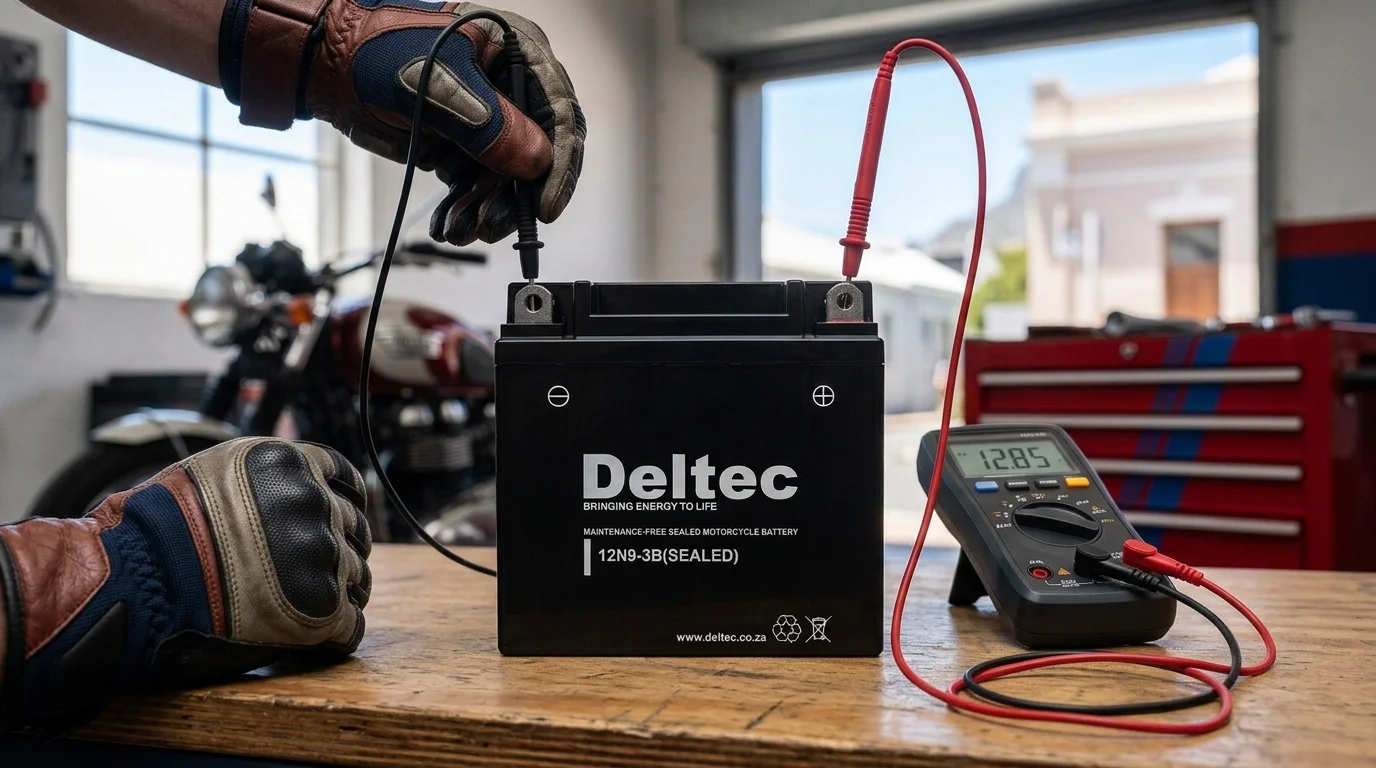
Before doing anything else, check the battery’s voltage before charging. Let the bike sit for at least half an hour with the engine off and no accessories running, then set your multimeter to DC voltage, connect the red lead to the positive terminal and the black lead to the negative terminal, and read the number.
What the Numbers Mean (Lead-Acid, AGM, and LiFePO4)
Your reading tells you exactly where your battery stands:
- 12.6V to 12.8V: a fully charged, healthy 12V lead-acid or AGM battery
- 12.4V and below: undercharged and in need of a top-up
- Below 12.0V: discharged, and the bike likely won’t start reliably
- Under 11.8V: a strong indicator the battery is failing rather than simply flat
If you’re running a LiFePO4 motorcycle battery, the numbers shift upward: a fully charged lithium battery reads roughly 13.3V to 13.6V, compared to 12.6V to 12.8V for AGM. Don’t panic if a lithium battery reads higher than you expect; that’s normal for the chemistry.
Why a Load Test Matters More Than Resting Voltage
Voltage alone doesn’t tell the whole story. A battery can show a completely normal resting voltage and still fail the moment it’s asked to deliver real starting power. That’s what a load test is for: it puts the battery under load and watches how the voltage holds up. A healthy battery dips slightly under load and recovers quickly, while a weak one collapses and stays low. No load tester on hand? Turn the ignition on with the headlight running, then hit the starter. If the headlight dims dramatically or cuts out, the battery likely can’t deliver enough current under real demand, even if the resting number looked fine.
Can You Revive a Battery That’s Lost Its Charge?
A low voltage reading isn’t necessarily a death sentence. In many cases, a proper charge is all it takes.
Safe Charging Steps
Use a smart charger designed for motorcycle batteries rather than a basic car charger, which can deliver too much current for a smaller battery. A quality charger will start with a gentle trickle and adjust automatically as the battery accepts charge, which protects it from overcharging while it recovers. Once charging is finished, let the battery rest for about an hour before testing voltage again, since a fresh charge can show an inflated reading until it settles.
Sulfation: When Recovery Works and When It Doesn’t
If your battery sat discharged or undercharged for an extended stretch over winter, it may be dealing with sulfation, a buildup of crystals on the internal plates that reduces capacity. The good news is that if a battery is serviced early, this kind of soft sulfation can often be corrected by applying a controlled charge. The bad news is that once a battery has sat at a low charge for weeks or months, the sulfation tends to harden and restoration becomes far less likely. If your battery won’t hold a charge after a full, proper charging cycle, that’s usually your answer.
Signs It’s Time to Replace, Not Recharge
Some symptoms point clearly toward replacement rather than another charge cycle.
Slow Cranking, Dim Lights, Repeat Discharge
Watch for a starter that cranks slowly or sounds strained, dash lights or headlights that dim noticeably when you hit the starter, and a battery that tests fine after charging but goes flat again within days. Any one of these on its own is worth a closer look. All three together usually mean the battery has reached the end of its useful life rather than just needing a top-up.
How Long Should a Motorcycle Battery Actually Last?
A motorcycle battery typically lasts between two and five years, depending on the chemistry, riding habits, and how well it’s maintained between rides. Lead-acid batteries tend to sit at the shorter end of that range, AGM batteries a little longer, and lithium options often outlast both. If your battery is already past the four or five year mark and showing any of the warning signs above, it’s more cost-effective to replace it than to keep nursing it through another season. You can browse our motorcycle battery range to find the right fit for your bike, and if you’re after a specific match, the Deltec FB-14L-A2 motorcycle battery is a reliable option built for a wide range of makes.
Is a Lithium Motorcycle Battery Worth It This Season?
If you’ve had two winters in a row where your bike wouldn’t start without a boost, it might be time to reconsider the battery chemistry itself, not just the battery.
Lower Self-Discharge Means Better Storage Survival
The core advantage of lithium is right there in the self-discharge numbers from earlier in this post: a fraction of what lead-acid loses each month. For riders who don’t ride through the wetter Cape winter months, that difference is the gap between a bike that starts first try in spring and one that needs a jump.
Lighter, Faster-Charging, Built for Riders Who Don’t Ride Daily
Beyond storage life, lithium batteries are noticeably lighter than lead-acid or AGM equivalents, which matters if you’re chasing every kilogram off your bike. They also accept charge faster, so a top-up before a ride takes less time. Deltec’s LiFePO4 batteries are built around this chemistry specifically for riders who want reliability without babying the battery every few weeks.
Protecting Your Battery Before Next Winter
A little prevention now saves you this exact headache again next year.
Trickle and Maintenance Chargers
If your bike is going to sit for more than a few weeks, connect it to a trickle or maintenance charger rather than leaving it disconnected and hoping for the best. These chargers monitor the battery and top it up automatically, keeping it in the healthy voltage range without any risk of overcharging.
Simple Habits for Seasonal Riders
If you don’t ride through the wetter winter months, build a quick habit around it: check your battery’s voltage once a month, keep it on a maintainer if it’s sitting for long stretches, and consider disconnecting it entirely if your bike will be parked for the full winter. These small steps take a few minutes and are far cheaper than a mid-season replacement.
Whether your battery just needs a charge or it’s genuinely time for a new one, Deltec Batteries has you covered. Visit us in Bellville or Tokai for a battery check, or browse our motorcycle battery range online. PayJustNow and PayFlex are both available if you’d rather split the cost over a few months instead of paying it all upfront.
Frequently Asked Questions
How long can a motorcycle sit before the battery dies?
It depends heavily on the battery type and whether it’s connected to the bike. A lead-acid battery with no parasitic draw might hold a charge for three to six months, but modern electronics can cut that down to just a few weeks. Lithium batteries handle extended storage far better thanks to their much lower self-discharge rate.
What voltage should a healthy motorcycle battery read?
A fully charged lead-acid or AGM motorcycle battery should read between 12.6V and 12.8V at rest. A LiFePO4 battery reads higher, typically 13.3V to 13.6V. Anything noticeably below these ranges means the battery needs charging or testing under load.
Can a motorcycle battery recover after going flat?
Often, yes, especially if it’s charged soon after going flat. A proper charge with a smart charger can restore a battery that’s simply undercharged. If the battery has sat at a low charge for weeks or months, sulfation may have set in, and full recovery becomes far less likely.
How do I know if my motorcycle battery needs replacing?
Slow cranking, dimming lights under load, and a battery that keeps losing its charge within days of a full recharge are all signs it’s time to replace rather than continue charging. Age matters too: most motorcycle batteries only last two to five years.
Do lithium motorcycle batteries handle storage better than lead-acid?
Yes, significantly. Lithium batteries typically lose only 1% to 2% of their charge per month compared to 5% to 10% for lead-acid, which is why they’re a popular upgrade for riders who don’t use their bike through the quieter winter months.
How often should I check my motorcycle battery during the off-season?
Checking voltage roughly once a month during any extended off-season is a good habit, and connecting the battery to a trickle charger removes most of the guesswork entirely by keeping it topped up automatically.

About Deltec Batteries
At Deltec Batteries we do more than sell batteries, we are a dynamic, forward-thinking company at the forefront of robust, efficient energy solutions – At home. At work. On the road – Wherever life takes you.
Follow Us
@deltecbatteriesbellville
@deltecbatteriestokai
@deltecbatteries
Shop Battery Deals

Motorcycle Batteries

Convenient payment

Earn Money Recycling

Recent Blog pOSTS